The Habitats
Directive (Directive 92/43/EEC)
The NATURA
2000 network
Sites of the NATURA 2000 network
in Greece
Greek NATURA 2000 dataset
EEA NATURA 2000 Map Viewer
The Habitats Directive (Directive
92/43/EEC)
The risk of extinction of many species and of degradation of many ecosystems has
led to the adoption of Directive 92/43/EEC "on the conservation of natural
habitats and of wild fauna and flora", by the European Council. The Directive
aims to "contribute to protecting biodiversity through the conservation of
natural habitats and of wild fauna and flora in the European territory of Member
States where the Treaty applies". The lists of habitat types and species are
included in Annexes I, II, IV and V of the Directive.
The Habitats Directive was transposed into natioanl law by a Joint Ministerial
Decision 33318/3028/1998, as amended by the Joint Ministerial Decision No.
14849/853/E103, FEK B 645 11.4.2008.
In the frame of Article 17 of Directive 92/43/EEC, Member States submit every
six years, national reports on the enforcement of the Directive. These reports
are prepared in accordance with a model approved by the European Commission. The
2nd national report on the implementation of the Habitats Directive (Directive
92/43/EEC) in Greece is presented below.
The 2nd national report on the implementation of the Habitats Directive
(Directive 92/43/EEC) in Greece (reporting period: 2001-2006) consists of
two parts: the first one (General Report) includes general information on the
conservation measures taken under the Habitats Directive on National Level
(legal framework, state of designation of Natura 2000, management issues,
conservation and mitigation measures, financing, species protection, etc.). The
second part focuses on the conservation status of the habitat types (Annex I)
and species (Annexes II, IV and V) of the Habitats Directive, present in our
country. It includes Habitat Types and Species Factsheets, accompanied by
range and distribution maps. The national reports of all member states will
be used by the European Commission (with the contribution of the European
Environment Agency and of the European Topic Centre on Biological Diversity) for
the preparation of a single composite report at biogeographical level. Those
interested can access the data of the 2nd national report from the following
link:
http://cdr.eionet.europa.eu/gr/eu/art17
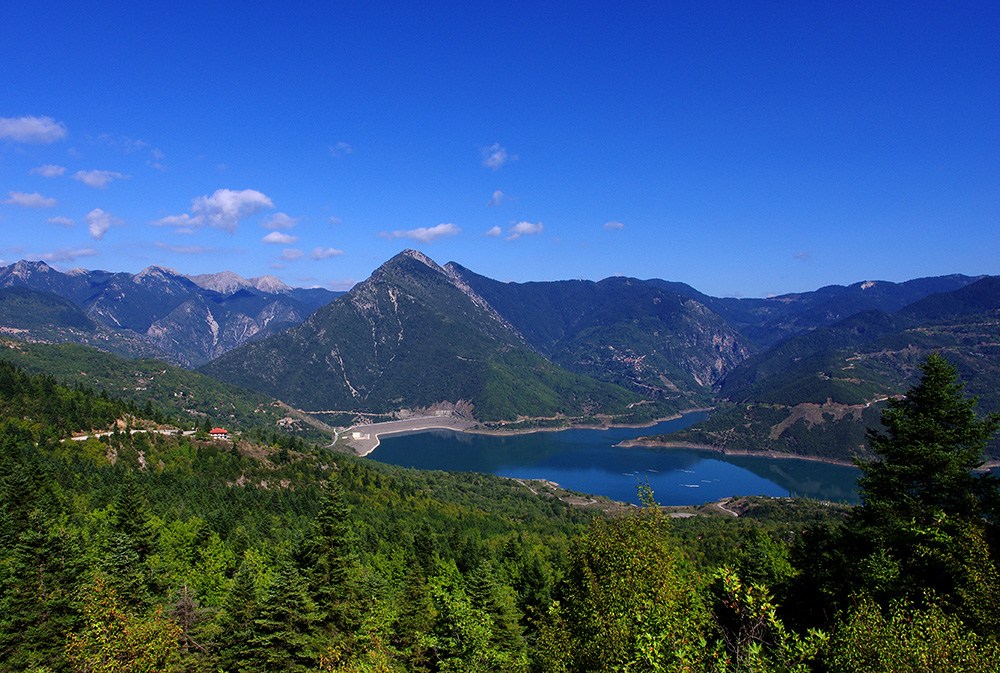
Greece with its rugged mountainous relief (42 summits over 2000m), its complex geology and the numerous islands and convoluted coastline (longer than the perimeter of France) presents a great diversity of natural scenery. In addition, the remoteness of some biotopes has led to the evolution of many endemic and rare animal and plant species. Equally interesting is the great variety of meteorological conditions that vary from dry semi-arid, semi-desert of SE Crete to the cold, humid continental climate of Rhodope mountain range bordering the Northern shores of the Aegean Sea.
The variety of the meteorological conditions combined with the geomorphological features reflects the rich flora and fauna. The diversity of the vegetation is evident by the large number of different habitats from the unique palm forest at Vai, on the eastern tip of Crete, to the boreal woods of birch, pines and spruce in Rhodope mountain range. This diversity is crowded into a very confined area; a journey of just 150 km from the town of Kavala to central Rhodope takes the traveller through Mediterranean, Central European and Northern (Scandinavian) vegetation zones.
In 1992 the Rio Convention and the EU Directive 92/43 were designed to confront the threat of extinction of many species and the deterioration of the worlds' habitats. The EU Habitats Directive 92/43 was incorporated into Greece's national legislation by the Joint Ministerial Decision 33318/3028/1998. The main aim of the Directive is to promote the maintenance or restoration of biodiversity, taking account of economic, social, cultural and regional requirements. The natural habitat types and the species are listed in Annexes I and II of the Directive. The backbone for the conservation and protection of the of the natural environment is the creation of a European ecological network of protected sites named NATURA 2000. The network, which will be under a special management committee consisting of representatives of the member states.
To achieve the goal for the identification and evaluation of biodiversity, the Directive was implemented in Greece in 1994 by a national project titled "Inventory, Identification, Evaluation and Mapping of the Habitat types and Flora and Fauna species in Greece". The creation of the NATURA 2000 network, to which Greece is committed, will assist in the protection of endangered species and their habitats by ensuring their restoration and maintenance at a favourable conservation status.
As regards the Mediterranean Biogeographical Zone, to where Greece totally belongs, the list of Sites of Community Importance has been defined and published at the official NewsPaper of EC, L259 vol.49 21/9/2006, that is available through: http://europa.eu.int
Sites of the NATURA 2000 network in Greece
Greece includes at its National List 241 Sites of Community Importance (SCI) according to the EU Directive 92/43 and has declared 202 Special Protected Areas (SPA) according to EU Directive 79/409. The boundaries of each site have been defined and displayed in maps on topographic background (scale 1:100000) and Standard Data Form has been completed with data on natural habitats and species of community importance.
The Directive imposes on the state the responsibility for making an appropriate assessment of any plan and/or programme likely to cause a significant effect on the conservation objectives of the site which has or will be designated in future. To accomplish this goal the state is empowered to implement all necessary protection and management measures in regard to the conservation objectives pursued.
Greek NATURA 2000 dataset (descriptive database and geospatial data)
The Greek NATURA 2000 dataset, including the descriptive database and the geospatial data, from the EIONET Central Data Repository (CDR) of European Environment Agency (EEA). The database is available in MsAccess format and the geographical data in GIS shapefile format.
![]() Database and GIS data of the Greek NATURA 2000 network (data up to May 2011) |
The user can save the database and the GIS data in a uniform zip file, by selecting the command “zip envelope” on the upper right corner of the website.
With the assistance of the European Environment Agency (EEA), the European Commission has developed a public NATURA 2000 Map Viewer, which is built on state of the art GIS technology and is accessible thought the URL: http://natura2000.eea.europa.eu. The Map Viewer provides the opportunity:
to navigate the European NATURA 2000 network of sites over different background layers, such as Street Map data, satellite imagery, CORINE LandCover, biogeographical regions, protected areas, etc;
to search for locations of interest, NATURA 2000 sites, species and habitats of interest;
to view useful information (name, code, area, perimeter) and photographs of a certain site;
to quick access the Standard Data Form of a certain site;
to print a map from the viewable map window.
|
Updated on 30/04/2010 - EKBY, 2010 |